Citizens Cemetery
Bristol, Virginia


Click the image below to view the Cemetery Directory produced in 2007

William Campbell (2019)
Well, my mother's the one that had really got me into finding out about my family history, and I've been checking her family records all the way back to slavery. That's what really got me involved with a lot of family history and in the Citizens Cemetery and trying to find out how many of my people were buried up there. I've got some great uncles and great aunts up there. It's on the far end of Piedmont Avenue on the Virginia side of town.

I wanted to know who was buried up in Citizens [Cemetery], because I knew I had people up there. At that time, it was overgrown; you couldn't see any headstones or anything. So we didn't really have Find a Grave, apps and stuff like that, to look up who was buried where.
So I had just started going to the Washington County Courthouse and talking to a lot of elderly Black people, finding out who might be up there. That's how I got involved in doing that. [I] talked to P.H. Robinson. He was basically a local historian . . . he was a funeral director. He knew everything about the Black community here. . . I talked to local historian Bud Phillips, who's a Bristol historian.
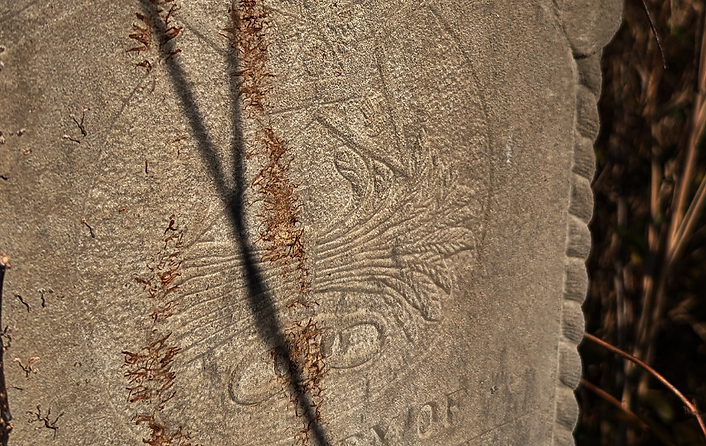
I started taking [whole] Saturdays, and just started digging up some of the old monuments that were there. Because they knew they were there. We just didn't know where they were . . . they would sometimes be a foot and a half down in the ground. I think I ended up finding, like, over 100 monuments in the ground.
At that time, the Sullen's Academy had decided they were considering renovating the whole Citizens Cemetery. They wanted it as a project to clean up. So they started coming over there, and they eventually cleaned it up along with the Citizens Association headed by Michael Carter; they were heavily involved in it. So they cleared it up quite a bit and put a whole new landscape up there, and cleaned up all the monuments. A lot of monuments were toppled over. They fixed the monuments. The only bad thing about it [is that] they put a whole layer of new sod on the whole six and a half acres, and in the process, they covered up almost all the monuments we dug up.
Now, we've still got monuments that are in the ground up there, and a little ticked off, but still. We made a map so you can kind of figure where a lot of the people are buried up there. We ended up making a booklet about all the people buried there. I'm in the process of updating it, because we've found quite a few. P.H. Robinson . . . he said he knew for a fact that there were people on top of people, because they really didn't keep accurate records of what was going on.
Going back a little bit to the history of Citizens [Cemetery], it was originally in an area called Flat Hollow. I got a lot of this information from Bud Phillips. It was an old slave cemetery that started around the 1830s. They just started burying slaves from the Susong and King families. The King family had a mansion in the area, and they owned a lot of acreage on the Virginia side. They started burying their slaves there, but after the Civil War, Black people continued to be buried there. I'm just assuming—I never did hear anything officially. I just assumed that the Kings owned so much property [that] they just said, "Well, we just don't mind [if] you keep burying people here." Because the Black people didn't own the property, but they kept burying the people there.
So there was a Citizens Cemetery group that came together. They had a bunch of trustees, and they oversaw everybody that was buried there. So there were Black people on the Virginia and Tennessee side buried there. It still didn't have a name. It was the Flat Hollow Cemetery, or sometimes called the Colored Cemetery, and they continued to bury people there. Then, in 1891, the King family decided to sell the property. It was becoming populated in the area, and they thought they wanted to sell it. Bristol Land Company, they were interested in building on that property, but they knew they couldn't build on top of the cemetery. So they decided, "Well, we'll exchange properties." When they bought the property, they brought a whole tract of land from the downtown area now on back to the Piedmont area, Piedmont Avenue. They decided, "Well, we'll see if the Black people will let us move all these graves over to Piedmont. We'll purchase this land and then sell them that land up there," and they decided they would do it.
So in 1891, the land was purchased, but it wasn't officially sold to the trustee committee. They were affiliated with the trustees of the John Wesley Methodist Church back then. So in 1904—I have the deed from Washington County—they officially bought the property up on where it is now, Piedmont, about six and a half acres on Piedmont. They started moving all the graves up there, and this took quite a while. They brought people from other cemeteries also. By the way, there were some White people up there, too. That was because it was kind of used as a pauper cemetery also. So quite a few poor White people were buried there along with Black people.
I don't know when it was officially named Citizens Cemetery, but it was still called the Colored Virginia Cemetery, the Colored Cemetery. I know I started seeing records, right [at] like 1915, where it was showing up as Citizens Cemetery. If anybody's watching this, if anybody's checking old records and things, if you have people from Bristol, be very careful in this time period. Because there's a second Citizens Cemetery on the Tennessee side, on Weaver Pike, and it was established in 1900.
[That one, on the Tennessee side] It's now called Citizens Cemetery, but in the old days, it was called Beidleman Cemetery, Colored Tennessee Cemetery, and the Colored Weaver Pike Cemetery. It was also renamed Citizens Cemetery, and I don't know exactly when. So there are some records that I looked up; I have no idea where the people are buried. Because they say they were buried in Bristol at Citizens, and I don't know Tennessee or Virginia. So we really couldn't establish [which one]. Sometimes, when I made the records out, I would put in our records that these people were shown as being buried at Citizens but [that] we're not sure if they're on this Citizens or the other Citizens. So you might want to check if you're a family member.
It's still a functioning cemetery. The last person buried was in 2005, and the oldest stone up there is from 1867, I believe. Like I said, there were quite a few well known Black people in this area at the time. [There] was the first Black lawyer up there. There's several doctors.
I've noticed recently, I think about a year ago, the records were put into Find A Grave, which is online. You can get online and search Find A Grave and find some of the people up there. But I'd be very careful about that, because sometimes I notice Find A Grave can be kind of tricky, and it may not be correct. So if you're looking up your family member, just be careful that you find the right person and the right place.
There's Whitten Pace. There are quite a few Paces up there, Fraction, Burley, Taylor. Oh yeah, the Heaths and the Savages and the Dykes and quite a few Johnsons. I forgot about the Browns, Cowans. Like I said, there were some that were, let's see, the Hortons and the Speeds and the Tabors. There are quite a few Hatchers up there also. I noticed in records, there were several people that, I guess maybe, were traveling through Bristol or something. They just died here, and they were buried up there, and they said they were from somewhere else. It's amazing how accurate some of the records can be that you would look up. Because the person doesn't have any kin people here, but they're actually buried up there in Citizens.
The Citizens Cemetery Committee maintains it right now, and they're always having fundraisers, too. They have a problem trying to raise money to keep it cleaned off, because it's pretty expensive to keep the grass cut and the weeds out of it and trees trimmed. They've been doing a really good job. It was in ridiculous shape. You could not even walk through there when it was overgrown.
I do have some distant cousins up there. See, I don't know exactly where they're buried. There's a family called the Morrisons, and it was a large family up there. They're on the very top of the hill, but they have no stones. I knew James Morrison pretty well, and I would ask him, "Why don't you guys have stones up there?" Because their family goes back decades, and nobody ever put a stone up there. There are so many families that there's no stones up there, and you don't know where they're buried.
There were quite a few. When we were up there working on the cemetery, quite a few caskets were coming up out of the ground. So there would be an edge of a casket that would be there, just coming up out of the ground.
You just realize that there were so many babies that were buried up there. Sometimes the baby would be a day old, sometimes it'd be a year old. . . And a lot of them just didn't have names. They'd just say Baby Campbell or whatever. There's quite a few babies that are buried up there, and that's just heartbreaking. You see what they died of, and you realize that today they would have lived. Back then they just couldn't do anything for them.